

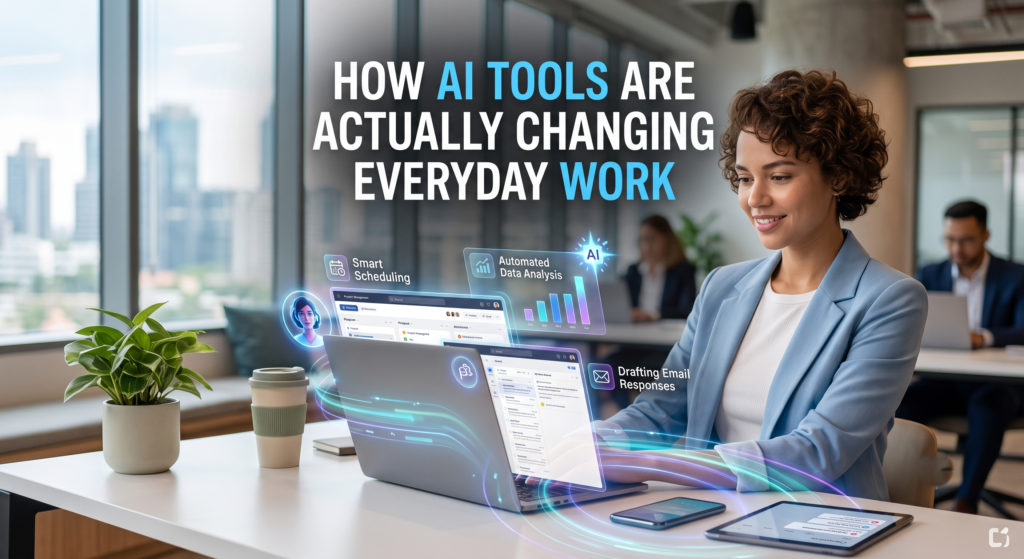
Every week brings a new headline about AI “revolutionizing” work. Most of it is noise. But underneath the hype, something genuinely useful has been happening: AI tools have quietly become part of how millions of people write, plan their day, and research information — not by replacing jobs overnight, but by removing small, repetitive friction points.
This post skips the buzzwords and looks at three areas where AI tools are making a measurable difference in everyday work: writing, scheduling, and research — along with honest notes on where they fall short.
1. Writing: From Blank Page to First Draft, Faster
The biggest practical shift isn’t that AI writes for people — it’s that AI removes the blank-page problem.
What’s actually changed:
- Drafting emails, reports, and routine documents takes minutes instead of an hour of staring at a cursor.
- AI tools are useful for restructuring messy notes into clear paragraphs, which used to be a manual editing chore.
- Tone adjustment (making something more formal, more concise, friendlier) is now near-instant, which matters a lot for people who write across different audiences all day.
Where it still falls short:
- AI-generated writing often needs fact-checking — it can sound confident while being wrong.
- It struggles with nuanced context specific to a company, team, or relationship history.
- Overused, it can flatten a writer’s natural voice if drafts aren’t edited afterward.
Practical takeaway: Use AI for structure and speed, not final judgment. Draft with it, edit with your own voice and knowledge.
2. Scheduling: Less Back-and-Forth, More Actual Planning
Calendar coordination used to eat up disproportionate amounts of time for something so administrative. AI scheduling tools have chipped away at this in a few concrete ways:
- Automated back-and-forth removal: AI assistants can propose meeting times based on everyone’s availability without the usual email chain.
- Smart prioritization: Some tools now flag which meetings are worth attending based on patterns in your calendar and stated priorities.
- Time-blocking suggestions: AI can suggest focus blocks around existing commitments, which is a small change that adds up over a work week.
Where it still falls short:
- These tools work best when calendars are accurate and up to date — garbage in, garbage out.
- They can misjudge priority for anything that isn’t explicitly labeled (like an informal but important conversation).
- Full automation of scheduling still makes many people uneasy about losing control over their own time — a fair concern, not just resistance to change.
Practical takeaway: Let AI handle the logistics (finding times, sending invites) but keep the judgment calls — what actually deserves a meeting — with a human.
3. Research: Faster Synthesis, Not Replaced Judgment
This is where AI tools have arguably made the most measurable difference for knowledge workers.
- Faster synthesis: Instead of opening 15 tabs, AI tools can summarize and compare sources, cutting initial research time significantly.
- Better first-pass understanding: For unfamiliar topics, AI explanations can get someone oriented faster than searching alone.
- Drafting outlines: Research-heavy tasks (reports, comparisons, competitive analysis) benefit from AI doing the initial structuring work.
Where it still falls short:
- AI tools can miss nuance, recent developments, or highly specialized/niche information.
- They can present information confidently even when it’s incomplete or outdated.
- Original sources still matter — AI research should be a starting point, not the final citation.
Practical takeaway: Use AI to get oriented quickly and identify what to dig into further, not as a substitute for verifying important facts.
So What’s the Real Shift?
The honest answer: AI tools haven’t replaced the core work of writing, planning, or researching. What they’ve done is remove friction — the blank page, the scheduling back-and-forth, the fifteen open tabs. That’s a real, measurable productivity gain, even without the more dramatic claims often attached to it.
The people getting the most out of these tools tend to treat them the same way: as a fast first draft, not a final answer — in writing, in scheduling, and in research alike.
Key Takeaways
The realistic benefit is less friction and faster starts — not full automation of judgment-based work.
AI writing tools speed up drafting but still need human editing for accuracy and voice.
AI scheduling tools reduce coordination overhead but shouldn’t make priority decisions alone.
AI research tools accelerate synthesis but require verification against original sources.



Hi, this is a comment.
To get started with moderating, editing, and deleting comments, please visit the Comments screen in the dashboard.
Commenter avatars come from Gravatar.