





















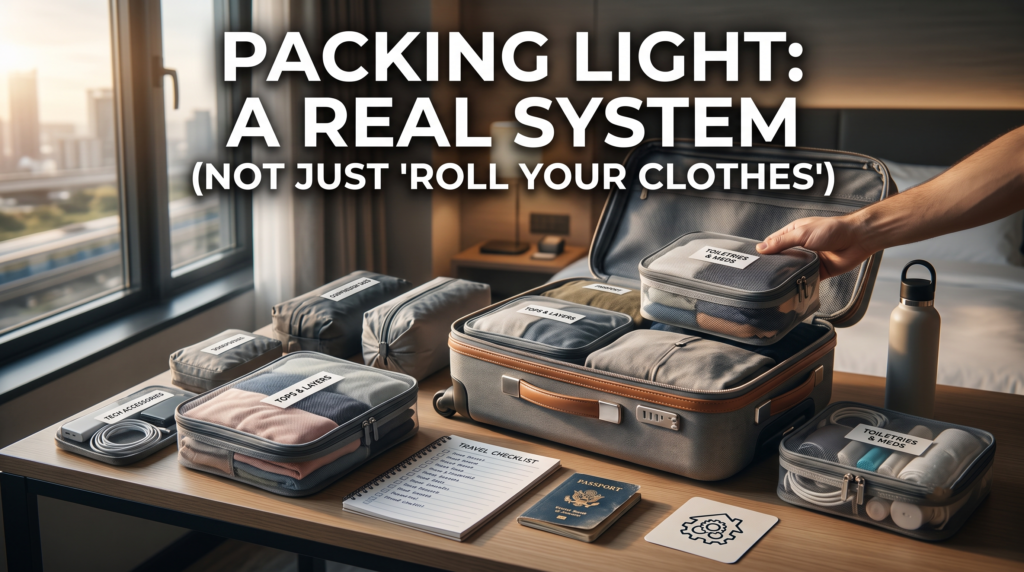
Most packing advice stops at “roll your clothes” and calls it a day. That helps a little, but real packing efficiency comes from a system — decision rules that determine what makes the cut before you even start folding anything.
Step 1: Set a Hard Container Limit First
Before packing anything, decide the bag size (carry-on only, one backpack, etc.) and treat it as non-negotiable. Constraints force better decisions than trying to pack “light” with no actual limit.
Step 2: Plan Outfits, Not Items
Instead of packing individual pieces, plan complete outfits that share pieces across multiple combinations. A well-chosen 5-6 item wardrobe can typically create 10+ outfit combinations if colors and layers are chosen deliberately.
- Stick to a limited color palette so everything mixes and matches.
- Choose one “dressier” option that layers with casual pieces, rather than a separate dedicated outfit.
Step 3: Apply the Laundry Math
Most trips don’t require a fresh outfit for every day — they require enough clothing to go about 4-5 days before needing a wash. For longer trips:
- Plan for one laundry cycle (hotel sink, laundromat, or hotel service) rather than packing 10+ days of clothes.
- This alone can cut luggage volume by more than half for longer trips.
Step 4: The One-In-One-Out Toiletry Rule
- Use travel-size or refillable containers only for what you’ll actually use in the trip length — most people over-pack toiletries “just in case.”
- Skip duplicate items already available at most destinations (this includes many toiletries, over-the-counter medication, and basic supplies).
Step 5: Layer for Climate Variability Instead of Packing Extremes
Rather than packing separate outfits for every possible weather scenario, use a layering system: a base layer, a mid layer, and one weather-resistant outer layer covers most climate variability without needing bulky, single-purpose items.
Step 6: The 24-Hour Rule Before Adding Anything “Just in Case”
If an item is being packed “just in case” rather than for a known, planned use, wait 24 hours before finalizing the packing list. Most “just in case” items don’t survive that reconsideration.
A Simple Carry-On Framework
- 5–6 tops, mixable across 2-3 bottoms
- 1 layering piece (jacket, cardigan, or similar)
- Sleepwear and undergarments for the wash cycle length
- 2 pairs of shoes maximum (one worn while traveling)
- A compact toiletry kit sized to trip length
- One “just in case” item, maximum
Why This Beats Generic Advice
Rolling clothes saves some space, but the real savings come from packing fewer, better-chosen items in the first place. A tight system beats a bigger bag every time — less to carry, less to lose track of, and faster to pack and unpack at each stop.
Key Takeaways
Give “just in case” items a 24-hour reconsideration period.
Set your bag size limit before packing anything.
Plan outfits and color coordination, not individual items.
Use the laundry math to avoid over-packing for longer trips.
Apply layering instead of packing for every weather extreme.