
























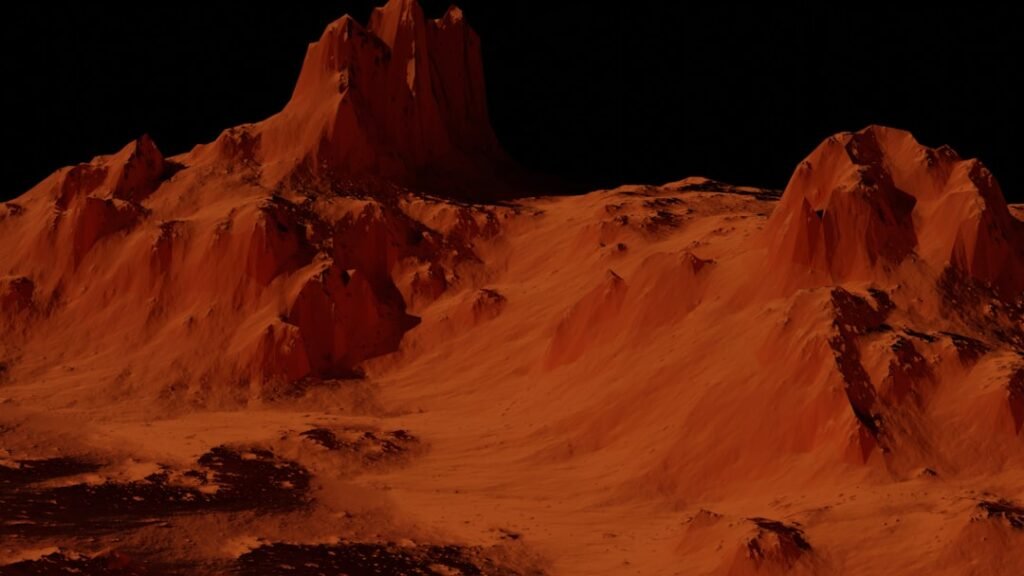
If you thought Mars couldn’t get any stranger, think again. NASA’s Curiosity rover has just stumbled upon one of the most visually striking and scientifically intriguing landscapes it has ever encountered — a sprawling field of honeycomb-shaped patterns blanketing an entire Martian valley. Researchers are calling it a ‘sea of polygons,’ and honestly, the nickname fits perfectly.
The discovery was made in a region known as Valle Grande, where Curiosity captured a stunning 360-degree panorama on June 19th and 20th (or sols 4,930 and 4,931 in Mars time). What the images revealed was nothing short of jaw-dropping: thousands upon thousands of geometric, hexagonal fractures stretching out in every direction as far as the rover’s cameras could see. Each individual polygon measures somewhere between 1.5 and 3 inches wide, forming an almost alien tiled floor across the valley floor.
Here’s what makes this find especially exciting — Curiosity has spotted these kinds of polygonal fractures before, but only ever in small, isolated patches. What Valle Grande is showing us is something on an entirely different scale. NASA scientists say they have never seen this type of formation spread so extensively across the Martian surface. Project scientist Ashwin Vasavada noted that the team has been working hard to measure and understand the full extent of this remarkable texture.
So what exactly causes these honeycomb patterns? On Earth, similar geometric cracking happens when wet mud dries out and contracts, or when frozen ground goes through repeated freeze-thaw cycles. Either explanation would carry massive implications for Mars, since both involve the presence of water or ice at some point in the planet’s past. Scientists are now working to determine which process — or perhaps a combination of both — is responsible for what Curiosity has uncovered.
This discovery adds yet another layer to the growing body of evidence suggesting that ancient Mars was once a far more dynamic, water-rich world than the cold, barren desert we see today. Every image Curiosity sends back chips away a little more at the mystery of what Mars used to be — and whether it could have ever supported life.
Keep your eyes on this story. As researchers continue analyzing the panorama and surrounding geology, we may be on the verge of learning something truly groundbreaking about our neighboring planet.