















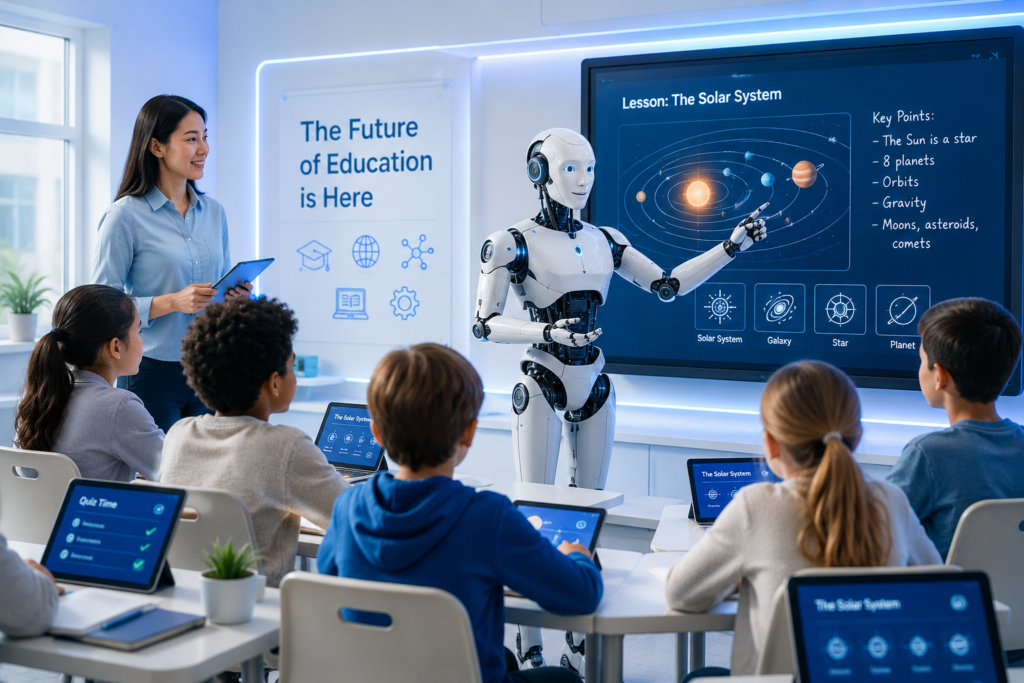
Imagine walking into a classroom where the teacher is not a person.
Instead, a humanoid robot stands at the front of the room, explains the lesson, answers questions, writes on a digital board, and adjusts the difficulty of each lesson based on how well students are learning.
It may sound like science fiction, but the idea of robots playing a role in education is becoming increasingly realistic.
As artificial intelligence, robotics, and automation continue to develop, one question is becoming harder to ignore:
Could robots one day run the classroom of the future?
Robots Are Already Entering Education
Robots are not completely new to schools.
Around the world, educational robots are already being used to help students learn programming, science, mathematics, languages, and other subjects. Some robots are designed to teach specific skills, while others act as interactive learning companions.
Artificial intelligence is also becoming part of the classroom through digital tutors, personalized learning platforms, and AI-powered educational tools.
These technologies can provide instant answers, generate practice exercises, explain difficult concepts in different ways, and adjust lessons according to a student’s progress.
That raises an important possibility: if technology can already help teach students, could increasingly advanced robots eventually take on the role of the main teacher?
What Would a Robot Teacher Actually Do?
A robot teacher would not necessarily look like a machine standing at a whiteboard giving lectures all day.
The classroom of the future could combine physical robots with artificial intelligence and digital systems.
A robot might be able to:
- Explain lessons in multiple ways
- Answer student questions instantly
- Translate lessons into different languages
- Monitor student progress
- Create personalized assignments
- Help students practice difficult subjects
- Identify areas where a student needs extra support
- Assist students with disabilities
- Provide interactive demonstrations
Instead of every student receiving exactly the same lesson, artificial intelligence could potentially create a more personalized learning experience.
One student might need extra help with fractions. Another might be ready for advanced mathematics. A smart educational system could adjust the learning experience for each student.
The Biggest Advantage: Personalised Learning
Traditional classrooms often have one teacher responsible for many students.
That can make individual attention difficult.
A student who understands a lesson immediately may become bored. Another student who is struggling may not receive enough one-on-one support.
AI-powered systems could potentially help close that gap.
A digital tutor or educational robot could repeat an explanation as many times as necessary without becoming frustrated. It could also change its teaching style.
If a student does not understand a written explanation, the system might use a diagram. If that does not work, it could provide an example, animation, or interactive exercise.
This could make learning more flexible and personal.
But Teaching Is About More Than Information
However, there is a major problem with the idea of completely replacing human teachers.
Education is not simply about transferring information from one source to another.
Teachers also encourage students, understand emotions, manage conflicts, inspire confidence, and recognize when something may be wrong.
A human teacher may notice that a student is unusually quiet, distracted, anxious, or upset.
A robot might detect changes in behavior, but understanding the human meaning behind those changes is much more complicated.
The relationship between a teacher and a student can also have a powerful effect on learning. Students often remember teachers who encouraged them, believed in them, or helped them through difficult moments.
That human connection is difficult to replace with technology.
Could Robots Become Teaching Assistants Instead?
Rather than completely replacing teachers, the more realistic future may involve robots and AI working alongside humans.
A teacher could remain responsible for the classroom while AI handles some of the more repetitive tasks.
For example, an AI system might help prepare lesson materials, grade certain assignments, provide additional practice, or answer routine questions.
A robot could assist with demonstrations, science experiments, language practice, or educational activities.
This would allow teachers to spend more time focusing on the parts of education that require human judgment and personal connection.
In this model, technology would not replace the teacher.
It would become a powerful assistant.
The Concerns Are Just as Important
The idea of AI and robots in education also creates serious concerns.
Privacy
Educational technology can collect large amounts of information about students.
This could include learning progress, behavior, performance, and other personal data.
Who owns that information? How is it protected? And who is allowed to use it?
These questions will become increasingly important as AI systems become more deeply connected to schools.
Dependence on Technology
Another concern is whether students could become too dependent on artificial intelligence.
If a machine is always available to answer every question, students may have fewer opportunities to develop independent problem-solving skills.
Education should not simply be about getting the fastest answer.
Students also need to learn how to think, question information, make mistakes, and discover solutions for themselves.
Inequality
Not every school has access to the same technology.
Wealthier schools may be able to afford advanced AI systems and robotics, while schools with fewer resources may struggle to provide basic educational tools.
If technology becomes a major part of education, unequal access could potentially increase the gap between students.
Would Students Even Want Robot Teachers?
This may be one of the most interesting questions.
Many students already use AI tools for homework, research, writing, and studying. Some may welcome technology that makes lessons more interactive and personalized.
Others may prefer learning from a real person.
A robot may be able to answer questions instantly, but it cannot necessarily replace the personality, humor, encouragement, and human connection that make a classroom memorable.
The answer may also depend on the subject.
Students might be comfortable learning mathematics from an AI system but prefer a human teacher for discussions about history, art, ethics, or social issues.
The Classroom of the Future May Be a Partnership
The future of education may not be about choosing between humans and machines.
Instead, the most effective classrooms may combine the strengths of both.
AI and robots can process information quickly, personalize lessons, automate repetitive tasks, and provide support at any hour.
Human teachers can offer empathy, judgment, creativity, encouragement, and emotional understanding.
Together, they could create a learning environment that is more personalized without losing the human side of education.
So, Will Robots Run Future Classrooms?
Possibly—but probably not in the way science fiction has imagined.
The most likely future is not a classroom where robots completely replace human teachers overnight.
Instead, technology may gradually take on more responsibilities.
AI could become a personal tutor. Robots could become classroom assistants. Digital systems could help teachers understand how students are learning.
Eventually, some classrooms may operate with far more automation than we see today.
But the central role of education may remain human.
Because teaching is not only about knowing the answer.
It is also about helping people learn how to ask better questions.
NXTBrief Take
Robots may become an important part of the future classroom, but replacing human teachers entirely could be much more difficult than simply building a machine that can explain a lesson.
The future of education may not be humans versus robots.
It may be humans and robots working together.
And perhaps the most important question is not whether a robot can teach.
It is whether a robot can truly understand what it means to learn.